
Table of Contents
- Why Sauna Health Benefits Matter for Busy Professionals
- Sauna for Stress Relief and Mental Clarity
- Cardiovascular Health and Blood Circulation
- Muscle Recovery and Post-Exercise Relaxation
- How Long to Stay in a Sauna for Maximum Benefit
- Sauna Use Frequency: Finding Your Optimal Schedule
- Sauna Safety and Risks You Should Know
- Frequently Asked Questions
Last Updated: October 9, 2026
Why Sauna Health Benefits Matter for Busy Professionals
Sauna health benefits matter because recovery happens outside the gym, not inside it. Muscles repair during rest, the nervous system resets in silence, and the cardiovascular system strengthens through stress-and-recovery cycles. Yet most professionals squeeze in workouts and skip recovery entirely.

Regular sauna use fits constrained schedules because it’s passive recovery, you’re not adding a task, you’re replacing screen time or commute stress with heat exposure your body adapts to. Professionals who integrate sauna sessions often report specific improvements in soreness and sleep quality after intense training.
The science is straightforward: heat exposure raises heart rate, dilates blood vessels, and activates heat-shock proteins that support muscle repair. Cold exposure afterward enhances circulation and reduces inflammation. These are measurable changes in how your body recovers.
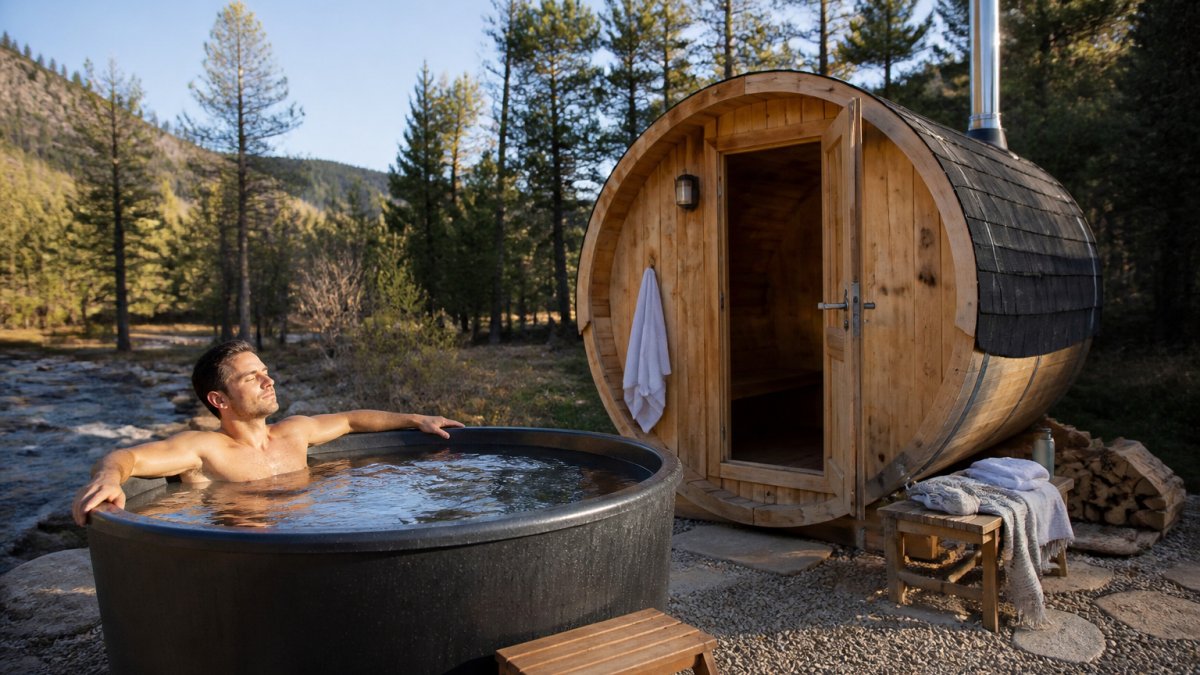
For busy professionals, the barrier isn’t understanding the benefits, it’s access and convenience. A wood-fired sauna rental removes that barrier: no commute, no booking around other people’s schedules. The sauna comes to your space and you use it on your terms.
Sauna for Stress Relief and Mental Clarity
Stress reduction from sauna use happens in two phases. During a session, heat triggers endorphins and reduces cortisol, while the quiet, tech-free environment forces your nervous system to downshift, no email, no notifications, just heat and silence.
After regular sessions, your baseline stress response improves and your nervous system becomes more resilient, what once triggered anxiety barely registers. That’s why frequency matters: one session helps temporarily, but consistent practice rewires stress tolerance.
Mental clarity follows because stress and mental fog are linked: chronically elevated cortisol makes the prefrontal cortex less responsive, and heat exposure plus relaxation let that system recover. Many professionals report their best thinking happens after a sauna session, not during.
The social component adds another layer: sharing a sauna rental with colleagues, clients, or friends creates space for genuine connection without the performance of a business meeting. That’s why Steam City Sauna’s white-glove delivery service appeals to teams and groups, the sauna becomes a setting for real connection, not another obligation.
Cardiovascular Health and Blood Circulation
Cardiovascular benefits are the most-studied area of sauna research, and where the gap between evidence and headlines is widest. Here’s a straight assessment of what’s well-supported, plausible, and overstated.
What’s well-supported. Acute sauna exposure reliably raises heart rate, increases cardiac output, and dilates peripheral blood vessels, the same hemodynamic response as light-to-moderate aerobic activity. A traditional session at 160 to 200 degrees Fahrenheit for 15 to 20 minutes typically pushes heart rate to 100-150 beats per minute.
What’s reasonably supported. Finnish cohort studies, the most-cited body of sauna research, associate frequent use (4 to 7 sessions per week) with lower rates of cardiovascular events and all-cause mortality than infrequent use (once weekly or less) (Sauna bathing is associated with reduced cardiovascular mortality and improves risk…).
What’s plausible but not established. Improved endothelial function, how blood vessel linings regulate dilation and blood flow, is a common claim. Mechanistically it makes sense: heat stress triggers heat-shock proteins and nitric oxide signaling, both supporting vascular health.
What’s overstated. Claims that sauna “replaces cardio” or produces the same cardiovascular adaptation as structured exercise are not supported. The hemodynamic response overlaps with light aerobic activity, but the training stimulus is different in magnitude, duration, and specificity. Sauna is a complement to cardiovascular training, not a substitute.
For a professional audience, the honest framing is this: sauna use is associated with better cardiovascular outcomes in large observational studies, produces measurable acute cardiovascular stress, and has plausible mechanisms for long-term benefit, but the causal evidence is not yet strong enough to promise outcomes. Use it as one input among several, not as a standalone intervention.
Why this matters for recovery. The acute circulation effects are the most reliably useful part for professionals: increased blood flow to skeletal muscle after training supports nutrient delivery and metabolic byproduct clearance. It’s a session-level effect, not a long-term adaptation, but it’s the one you can count on. Use sauna for post-training recovery and you’re on solid ground; use it to prevent heart disease and you’re relying on an association, not a guarantee.
The cold contrast question. Combining sauna with cold plunge produces a stronger acute vascular response, constriction followed by dilation, and many practitioners report better subjective recovery. But evidence that contrast therapy outperforms sauna alone is mixed and study quality is low.
American Heart Association physical activity guidance
Muscle Recovery and Post-Exercise Relaxation
Muscle soreness after intense training comes from mechanical damage and inflammation. Heat accelerates both repair and inflammation resolution: blood flow to muscles increases dramatically, nutrients and repair hormones reach damaged tissue faster, and inflammatory markers begin to clear.
Heat also promotes muscle relaxation directly: warm muscles are more flexible and less prone to tension. If stretching is easier after a hot shower, that’s the same principle at scale, a sauna session gives muscles extended time to genuinely relax rather than remain guarded.
Post-exercise recovery isn’t just physical. Intense training activates your nervous system, and the parasympathetic “rest and digest” activation in a sauna counterbalances that. You’re recovering your entire system, not just your muscles.
Steam City Sauna rentals let you build this into your training cycle deliberately: after a heavy lifting session or intense conditioning, you schedule a sauna and cold plunge. Your body gets the signal that recovery is a priority, not an afterthought.
How Long to Stay in a Sauna for Maximum Benefit
The ideal duration for a sauna session is 15 to 20 minutes for most people. This timeframe allows your body temperature to rise sufficiently to trigger the physiological adaptations you’re after without excessive stress. Shorter sessions (under 10 minutes) provide some benefit but don’t give your body enough time to fully activate heat-shock protein production. Longer sessions (over 30 minutes) increase risk without proportional benefit gains. Consistent heat exposure serves as a foundational element within a broader framework of regenerative wellness practices that support sustained recovery from the demands of a high-pressure career.
Your first few sessions should be shorter, around 10 to 15 minutes, while your body adapts to heat stress; extend toward 20 minutes as you acclimate. If you feel lightheaded, dizzy, or extremely uncomfortable, exit early. Sauna health benefits come from consistent, sustainable practice, not from pushing to extremes in a single session.
Temperature matters as much as duration. A traditional sauna runs between 160 and 200 degrees Fahrenheit; wood-fired saunas often settle around 180, hot enough to trigger adaptation without being dangerous for most people. The hotter the sauna, the shorter the session, very hot saunas (over 200 degrees) warrant 10 to 15 minutes maximum.
Between heat exposure and cold plunge, rest 5 to 10 minutes. Let your heart rate normalize. Drink water. This rest period is when your body begins processing the stimulus and initiating recovery. Rushing from sauna to plunge to sauna again doesn’t amplify benefits. It just stresses your system unnecessarily.
Sauna Use Frequency: Finding Your Optimal Schedule
The most-cited research on sauna frequency points to a dose-response pattern: roughly 3 to 4 sessions per week is where cumulative cardiovascular and stress-adaptation benefits show up most consistently.
Here’s a practical way to think about it, based on how recovery stress stacks up across a typical professional week.
Baseline maintenance: 2 sessions per week. If you train 2 to 3 days per week and work a desk job, two 15-to-20-minute sessions maintain the stress-resilience and sleep-quality effects.
Peak load: 4 to 5 sessions per week, short duration. During a deload week, a competition block, or an unusually intense work period, more frequent but shorter sessions (10 to 15 minutes) can be more sustainable than fewer long ones.
Anchor sauna sessions to events you already have on the calendar, the end of a training session, the end of the workday, or a Sunday evening reset. Habit stacking beats willpower when your schedule is unpredictable.
Travel weeks. Many full-service hotels and athletic clubs have saunas. If you’re traveling, treat a sauna as a substitute for one missed training session rather than an addition, a single 15-minute session mid-trip preserves the stress-adaptation signal without adding recovery debt.
When you’re sick or under-slept. Skip it. Heat exposure is itself a stressor. If your resting heart rate is elevated, you slept poorly, or you’re fighting something off, a sauna session adds load your body can’t absorb.
Consistency beats intensity. Two 15-minute sessions every week for six months produces more durable cardiovascular and nervous-system adaptation than four 30-minute sessions for three weeks followed by nothing.
If you’re renting a sauna rather than using a facility, plan your rental windows around your highest-stress or highest-training weeks. Two to three well-timed rentals per month, scheduled deliberately, will outperform an irregular pattern of “whenever I get around to it.”
Sauna Safety and Risks You Should Know
Sauna use is safe for most people, but some should exercise caution. If you have uncontrolled high blood pressure, heart disease, or a history of fainting, consult your doctor first.
Dehydration is the most common risk. Heat causes significant fluid loss through sweating. If you don’t drink enough water before, during (if possible), and after your session, you risk dehydration, which can trigger headaches, dizziness, and worse. Always hydrate deliberately.
The contrast between extreme heat and cold water carries its own risk. If you have cardiovascular issues, the sudden blood vessel constriction from cold plunges can stress your heart.
Never sauna alone if you’re new to the practice: heat, dehydration, and blood pressure changes can cause fainting, and having someone present ensures help if you need it. This matters most for the first few sessions; once you understand how your body responds, solo sessions become safer.
Avoid saunas if you’re acutely ill. A fever, active infection, or recent illness means your immune system is already stressed. Heat exposure adds additional stress your body can’t handle effectively. Wait until you’ve fully recovered before resuming sauna use.
Sauna health benefits deliver real recovery when you approach them strategically, not as a trendy wellness add-on. The cardiovascular adaptations, stress reduction, and muscle recovery are measurable and consistent across people who practice regularly.
Steam City Sauna makes this accessible. Our wood-fired sauna rental service delivers the setup, the supplies, and the white-glove experience, so you focus on recovery, not logistics. Whether you’re hosting a team event, planning a celebration, or building a personal recovery ritual, we handle the details.
Frequently Asked Questions
What are the main sauna health benefits for professionals?
Regular sauna use supports cardiovascular health by improving blood circulation and vascular function. It reduces muscle soreness after intense training, lowers stress levels through relaxation, and improves sleep quality. For busy professionals, sauna sessions offer a tech-free recovery ritual that fits into limited schedules. Heat exposure also triggers the release of endorphins, improving mood and mental well-being. Many professionals use sauna health benefits as part of their overall wellness strategy to maintain performance despite demanding work schedules.
How often should you use a sauna for health benefits?
Research suggests that regular sauna use, typically 2-4 sessions per week, produces the most consistent health outcomes. However, sauna use frequency depends on your fitness level, recovery needs, and schedule. Athletes recovering from intense training may benefit from more frequent sessions, while wellness-focused professionals might find 1-2 sessions weekly sufficient for stress reduction and circulation improvement. Start with once weekly and adjust based on how your body responds. Always allow at least one rest day between sessions to let your body fully recover.
Who should avoid using a sauna or talk to a health care professional first?
Certain groups should consult a healthcare provider before sauna use: people with uncontrolled high blood pressure, heart conditions, or recent cardiovascular events; pregnant women; those taking medications that affect heat tolerance; and individuals with severe dehydration or acute illness. People with respiratory conditions should also seek medical guidance. If you have any chronic health condition or take prescription medications, discuss sauna safety and risks with your doctor to ensure it’s appropriate for your situation.
Can sauna use help with stress relief and daily mood?
Yes. Heat exposure in a sauna triggers the release of endorphins and reduces cortisol levels, both of which lower stress and improve mood. The relaxation response during a sauna session also calms your nervous system, making it an effective stress reduction tool. For professionals, sauna for stress relief offers a screen-free escape from work demands. Regular sauna sessions have been linked to improved mental well-being and better sleep quality, which further supports mood stability and stress management throughout your week.