
Table of Contents
- How Sauna Therapy for Stress Relief Affects Your Body
- How Long to Stay in a Sauna for Stress Relief
- Infrared vs. Traditional Sauna: Which Works Better for Stress?
- The Social Benefits of Sauna Bathing: Why Shared Heat Builds Connection
- Benefits of Cold Plunge and Sauna: The Hot-Cold Ritual for Recovery
- Sauna Therapy for Stress Relief: Building a Weekly Practice
- Frequently Asked Questions
Last Updated: September 17, 2026
How Sauna Therapy for Stress Relief Affects Your Body
Sauna therapy for stress relief works because heat triggers measurable shifts in hormone balance and nervous system activity. This guide from Steam City Sauna breaks down what happens physiologically, how long to stay in, and how to build a practice that actually sticks.
Cortisol Regulation and the Autonomic Nervous System
Cortisol, your primary stress hormone, follows a daily rhythm. Chronic stress disrupts that rhythm, keeping cortisol elevated when it should be dropping. Heat exposure appears to support cortisol regulation by giving the autonomic nervous system a controlled stressor to recover from. The sympathetic nervous system activates briefly during heat exposure, then hands off to parasympathetic activation during cooling.
Endorphin Release and Mood Enhancement
Endorphin release during and after sauna bathing contributes to the mood lift many regular users describe. Heat also triggers the release of heat shock proteins, which support cellular repair and may play a role in reducing systemic inflammation. The result is a measurable shift in how you feel for hours after a session.
How Long to Stay in a Sauna for Stress Relief
The ideal session length for stress relief is 10-20 minutes per round, repeated 2-4 times with cooling breaks between. Beginners should start at 10 minutes and build gradually. The reason duration matters is that the cortisol and endorphin response follows a curve: too short and you never trigger the sympathetic-to-parasympathetic handoff, too long and the heat stress itself starts working against the relaxation response.
- Round 1: 10-12 minutes, then cool down for 5-10 minutes
- Round 2: 12-15 minutes, then cool down again
- Round 3 (optional): 15-20 minutes if you feel comfortable
- Total session: 45-60 minutes including breaks
Frequency: How Often for Stress Relief
Most practitioners find that 2-3 sessions per week produces the most consistent stress-relief benefit. Some research on frequent sauna bathing and cardiovascular outcomes has looked at 4-7 sessions per week, but for stress-specific goals, consistency across weeks matters more than total weekly volume. A person who does three sessions every week for two months will typically report more benefit than someone who does seven sessions in one week and then stops.
Hydration and Electrolytes
Heat exposure drives fluid loss through sweat. Drink 16-20 ounces of water in the hour before a session, sip during cooling breaks, and replace electrolytes if you are doing multiple rounds or combining sauna with cold plunge. Alcohol before or during a session is a hard no, it compounds dehydration and impairs your ability to judge how much heat stress you are under.
When to Stop Immediately
Stop the session and cool down gradually if you experience:
- Dizziness or lightheadedness
- Nausea
- A headache that builds during the round
- Heart palpitations or a pulse that feels irregular
- Sudden chills or confusion
Who Should Talk to a Doctor First
Sauna bathing is generally well tolerated, but check with a physician before starting if you are pregnant, have cardiovascular disease, take blood pressure medication, have uncontrolled diabetes, or are recovering from a recent illness with fever. The American Heart Association has noted that heat exposure places demands on the cardiovascular system, and those demands should be cleared with a clinician if you have a known heart condition.
Never combine sauna use with alcohol or recreational drugs. The combination raises the risk of fainting, arrhythmia, and heat injury, and it undercuts the nervous-system benefit you are there to get.
Cooling Breaks Are Part of the Session
A cooling break is not downtime, it is when the parasympathetic rebound happens. Step out, sit in a cooler room or step into a cool shower, and let your breathing settle before returning. Rushing straight back into the heat skips the recovery half of the stress-relief cycle.
Infrared vs. Traditional Sauna: Which Works Better for Stress?
Traditional saunas heat the air around you to high temperatures, while infrared saunas emit radiant heat that warms your body directly at lower air temperatures. Both produce stress relief, but the mechanisms differ, and most comparison articles stop at that sentence. The more useful breakdown separates the three heat types people actually encounter.
Traditional Finnish Sauna
Air temperature typically reaches 160-190°F with low humidity, or higher with steam from water thrown on the rocks. The stress response is driven by ambient heat: your core temperature rises, blood vessels dilate, heart rate climbs, and the sympathetic nervous system activates. The cooling break is where the parasympathetic rebound happens. For stress relief specifically, the intensity of the thermal swing tends to produce the strongest relaxation response, which is why traditional sauna is often the reference point in research on sauna bathing and cardiovascular health.
Far-Infrared Sauna
Far-infrared cabins emit radiant heat in a wavelength range that warms tissue more directly, at air temperatures around 120-140°F. Because the air is cooler, sessions can run longer and feel less oppressive. Users who find high ambient heat uncomfortable, or who want to read, stretch, or sit with friends without intense sweating, often prefer this format.
Near-Infrared Sauna
Near-infrared panels emit shorter wavelengths that penetrate shallowly and are often marketed for skin and surface-tissue benefits rather than deep heat stress. For stress relief, near-infrared is the weakest of the three on its own because it does not raise core temperature as effectively. It is best understood as a complement to far-infrared or traditional heat, not a replacement.
| Factor | Traditional Finnish | Far-Infrared | Near-Infrared |
|---|---|---|---|
| Air temperature | 160-190°F | 120-140°F | 110-130°F |
| Heat delivery | Ambient air + steam | Radiant, deeper tissue | Radiant, shallow tissue |
| Session feel | Intense, shorter rounds | Gentler, longer sessions | Mild, often combined |
| Stress-relief strength | Strongest thermal swing | Moderate, sustained | Weakest alone |
| Best for | Cardiovascular conditioning, deep relaxation | Joint comfort, longer sessions, reading | Skin-focused routines |
| Sweat onset | Fast | Slower | Slowest |
Which One for Stress Relief?
For pure stress relief, traditional heat tends to produce the strongest relaxation response because the thermal stress is greater and the cooling contrast is sharper. Far-infrared suits people who find high heat uncomfortable, want longer sessions, or are sharing the sauna with friends who have different heat tolerances. Near-infrared is best treated as an add-on.
A Note on Shared Sessions
One practical advantage of far-infrared cabins is that the lower air temperature makes it easier to sit and talk with friends for a full session without anyone needing to bail out early. That matters for stress relief because the social component, screen-free time with people you trust, is doing real work alongside the heat. A traditional sauna can deliver the same benefit, but the group needs to be comfortable with shorter, hotter rounds and more frequent cooling breaks. Either way, the phone stays outside.
If you are choosing a format primarily for stress relief and you plan to use it socially, far-infrared often wins on usability. If you want the strongest physiological stress response and your group tolerates heat well, traditional wins on intensity.
The Social Benefits of Sauna Bathing: Why Shared Heat Builds Connection
The social benefits of sauna bathing extend well beyond relaxation. Sitting in a sauna with friends creates a shared experience that’s hard to replicate elsewhere, largely because there are no phones, no screens, and no distractions.
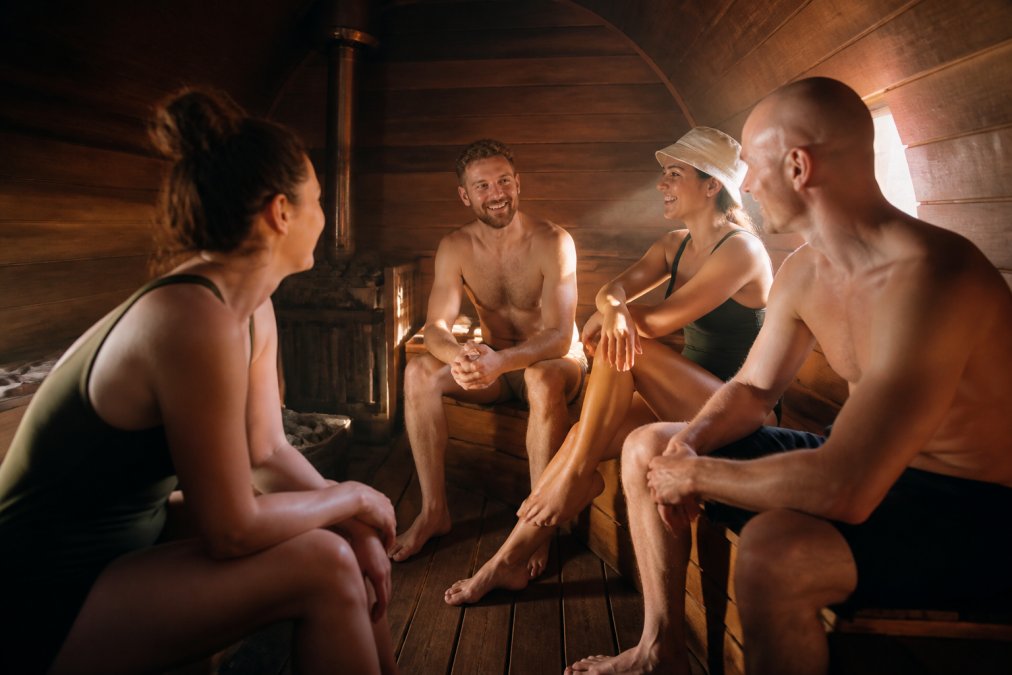
The screen-free nature of a sauna session is a feature, not a limitation. Most people get their best conversations in the sauna precisely because there’s nothing else competing for attention.
Benefits of Cold Plunge and Sauna: The Hot-Cold Ritual for Recovery
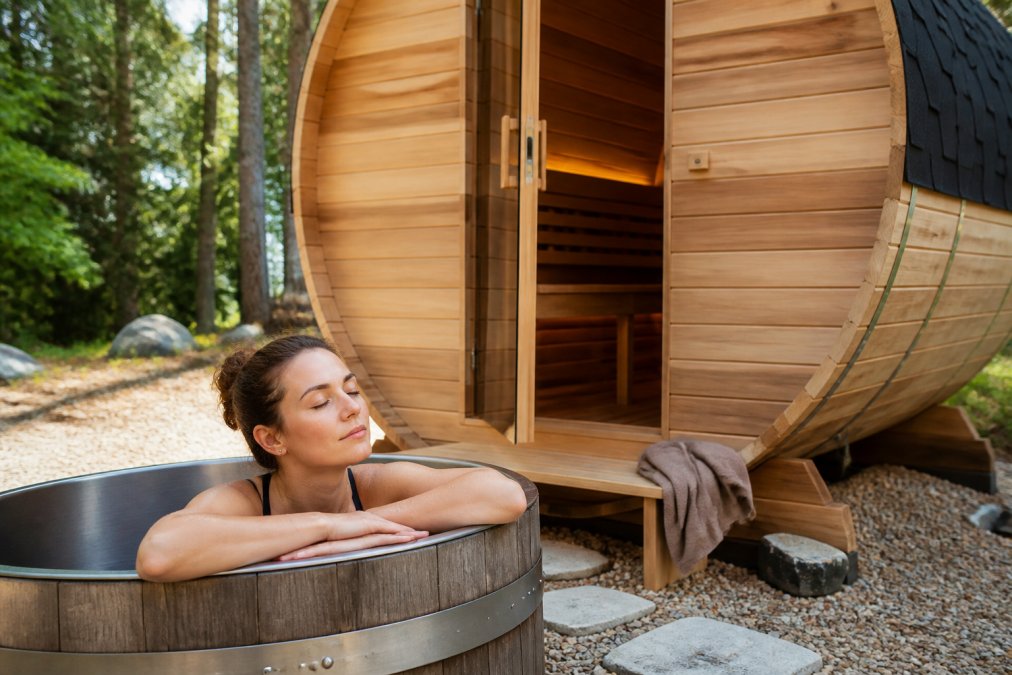
The benefits of cold plunge and sauna come from contrast. Alternating heat and cold creates a vascular workout: heat opens blood vessels (vasodilation), cold constricts them. Repeating that cycle improves blood flow circulation and accelerates muscle recovery.
A basic hot-cold protocol:
- Sit in the sauna for 10-15 minutes
- Cool down in cold water for 1-3 minutes, or until your breathing settles
- Return to the sauna for another 10-15 minutes
- Repeat 2-4 times total
- End on cold for an energizing finish, or on heat for deeper relaxation
Skipping the cool-down phase can leave you feeling lightheaded and can blunt the stress-relief benefit. Give yourself 5-10 minutes of gradual cooling before you resume normal activity.
Sauna Therapy for Stress Relief: Building a Weekly Practice
Consistency beats intensity. A sustainable routine is 2-3 sessions per week, each lasting 45-60 minutes including breaks. The psychological habit formation piece is what most guides skip: attach your sessions to an existing routine, like a specific weekday evening or right after training, so the decision is already made for you.
A weekly structure that works for most people:
| Day | Session Type | Focus |
|---|---|---|
| Monday | Sauna only | Recovery after training |
| Wednesday | Sauna + cold plunge | Circulation and mood |
| Saturday | Social sauna with friends | Connection and stress relief |
The most effective stress-relief practice is the one you’ll actually repeat. Two to three sessions per week, ideally shared with people you like, outperforms an ambitious daily plan you abandon after a month.
Frequently Asked Questions
How does sauna therapy impact cortisol levels?
Sauna therapy triggers a controlled rise in cortisol during the session as your body responds to thermal stress, then cortisol typically drops below baseline during recovery. Over time, regular sauna bathing supports cortisol regulation by training your autonomic nervous system to shift from sympathetic (fight-or-flight) to parasympathetic (rest-and-digest) activation. This is why many people report feeling calmer and less reactive after consistent sauna use.
How long should a sauna session be for maximum stress relief?
Most people get the best stress relief from 15 to 20 minutes per session at a comfortable heat level. Beginners should start with 10 to 12 minutes and build up gradually. The key is listening to your body: if you feel dizzy or uncomfortable, step out. Two to three rounds of 15 minutes each, with a cool-down between, is a common pattern for deeper relaxation.
What are the social benefits of sauna bathing?
Shared sauna time creates a screen-free space where conversation happens naturally. The heat relaxes tension, which makes people more open and present with each other. For families, friend groups, or event guests, sauna bathing offers a bonding experience that feels both restorative and social. Many people find it easier to talk about stress or personal things in a sauna than in a normal social setting.
What are the benefits of cold plunge and sauna together?
Alternating sauna heat with cold plunge creates a powerful circulation boost through vasodilation and vasoconstriction. This combo can reduce muscle soreness, improve heart rate variability, and sharpen mental focus. The cold plunge also extends the relaxation response after you finish the sauna, helping you stay calm for hours. Start with 30 to 60 seconds in cold water between sauna rounds.